

If your New Year’s resolution was to get in shape last year and you quit — this is why.
Motivation fades. Habits don’t.
Every January, people rely on the hype, unsustainable discipline, and willpower. When it works, it works. It works for a week… maybe two. Then life hits, motivation drops, and 2027 will be your year instead now.
In 2026, the goal isn’t to try harder; it’s to build routines that run automatically, the same way your boss may choose to do nothing all day, whilst the muscle (you) gets dirty.
This guide explains why habits beat motivation for fat loss and fitness, and exactly how to build them so they stick.
Why habits beat motivation (every time!)
A habit is a behaviour anchored to your day. Once it’s familiar, you do it without thinking.
That’s powerful.
Your brain prefers:
- Familiar actions
- Low decision-making
- Predictability
That’s why bad habits are easy to repeat — and why good habits work once they’re established.
When fitness becomes a habit:
- Training stops newbishly feeling hard
- Starting no longer requires willpower
- Consistency becomes automatic
The real challenge isn’t exercise… It’s making the behaviour feel normal.
Why fitness feels hard at the start
Running 5 km or lifting heavy after years of inactivity feels brutal because it’s unfamiliar.
Your brain sees it as a threat, not a reward.
Your solution?
Shrink the habit until it feels safe and repeatable.
Examples of habits you never think about
These actions happen on autopilot:
- Brushing your teeth
- Driving to work
- Doom scrolling
- Eating fries before the burger
- Choosing a large drink over a small one
You don’t negotiate with these habits; you just do them.
That’s exactly where fitness needs to exist in your life!
Motivation is short-term fuel
Proned to stalling!
Motivation is like caffeine.
It spikes fast, feels amazing… and then boom, crashes.
A routine is like sleep:
- Reliable
- Sustainable
- Long-lasting
If you rely on motivation, you’ll always restart.
If you build habits, you won’t need to.
Routine vs Motivation
| Routine | Motivation |
| Automatic repetition | Depends on mood |
| Low mental effort | High willpower |
| Consistent results | Inconsistent effort |
| Long-term fat loss | Short-term bursts |
Takeaway:
Consistency beats intensity!!
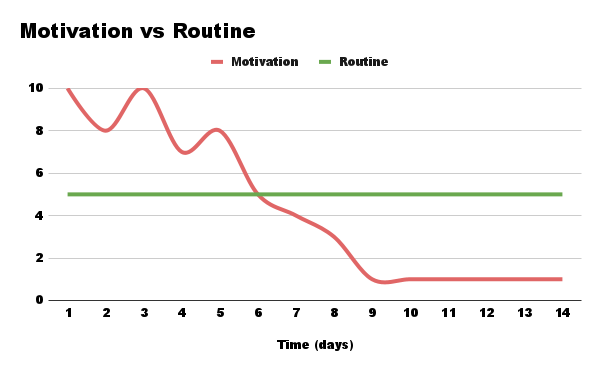
Visualised here, motivation is most potent at the beginning, but eventually fades.
The first week might be epic and highly productive, but as the days tick away, it ultimately collapses.
Most habits start with motivation (ironically)… and that’s okay
Motivation isn’t useless.
It’s useful for starting.
But if you don’t turn that motivation into a routine before it fades, you relapse.
The winners build structure while motivation is still high.
Step 1: Break big goals into tiny habits
Start broad, then narrow it down.
For Example:
Goal: Lose 20 kg
Ask:
- How? → Eat less ✔️
- How exactly? → Reduce fast food ✔️
- Replace with what? → Smaller desserts ✔️
Final habit:
Eat ¼ of a donut instead of one full donut
This is how habits stick:
- Small
- Repeatable
- Non-threatening
Progress comes later.
Step 2: Use rules, not motivation
Rules remove decision-making.
Examples:
- “I train after work.”
- “I walk to the office.”
- “I hit my protein target daily.”
No debates. No excuses.
Just making it happen.
Each time you follow a rule, your brain releases dopamine, which reinforces the habit!
Step 3: Stack habits slowly
Trying to change everything at once causes burnout. Especially when it’s too broad.
Instead:
- Lock in one habit
- Wait until it feels automatic
- Add the next
If it doesn’t feel effortless yet, it’s too early to stack.
Your 2026 habit-building game plan
- Choose one small habit
- Turn it into a daily rule
- Use motivation to start
- Repeat until automatic
- Stack the next habit
Do this, and you won’t need motivation in 2026.
You’ll have routines that carry you forward, even on bad days.
That’s how real transformation happens.
Good luck, everyone, and make it happen! <3
U da real fitness, bro.